A potential customer opens ChatGPT and types: "Which HubSpot partner should I use in Australia for construction CRM setup?"
Three companies get named. Yours isn't one of them.
You don't even know this happened. There's no search console for it. No click data. No impression count. Someone was actively looking for what you do, an AI told them who to use, and you weren't in the conversation.
That's the problem Answer Engine Optimisation solves.
We've been watching this shift closely at Gather 'n' Grow. As a HubSpot Platinum Partner working with construction, outsourcing, and B2B services clients, we're seeing the early signals of something that's going to reshape how businesses get found. Not in five years. Right now.
And here's the thing - this isn't about replacing what you already do with SEO. It's about adding a layer that most of your competitors haven't thought about yet.
What Is Answer Engine Optimisation?
Let's keep this simple.
Traditional SEO helps you rank in a list of search results. When someone googles "best CRM for construction companies," you're trying to land on page one so they click through to your site.
AEO is different. It's about being the answer that AI gives directly.
When someone asks ChatGPT, Gemini, Perplexity, or Copilot a question, those tools don't show a list of ten blue links. They give one answer. Maybe they name two or three companies. Maybe they recommend a specific approach. The user gets what they need without ever visiting a website.
So the question becomes: when AI is doing the recommending, are you the one being recommended?
Here's a quick way to think about the difference:
SEO asks: How do I rank higher in search results?
AEO asks: How do I become the answer AI gives?
SEO focuses on: Keywords, backlinks, page speed, technical structure.
AEO focuses on: Brand signals, third-party mentions, structured content, credibility across the web.
SEO traffic looks like: Someone clicks a link and visits your site.
AEO traffic looks like: Someone already trusts you before they ever land on your page - because AI told them you're worth talking to.
They're not competing. SEO builds the foundation that AEO benefits from. But AEO adds something SEO alone can't deliver: presence in AI-generated recommendations.
Why This Matters Right Now
We could frame this as "the future of search" but honestly, it's already the present for a lot of buyers.
Here's what the numbers look like:
- ChatGPT alone has over 900 million weekly active users. That's not a niche audience experimenting with a new tool. That's a mainstream behaviour shift.
- Early adopters are reporting that 10-15% of their leads now come from AI-sourced discovery. People who found them because an AI recommended them, not because they clicked an ad or a search result.
- Some businesses have seen 8,000+ new website visitors from AI referral traffic after deliberately optimising for it.
And the shift isn't limited to ChatGPT. Google's AI Overviews now appear in a significant portion of search results. Perplexity is growing fast. Microsoft Copilot is baked into the tools millions of people use daily. Even Apple's Siri is getting smarter about pulling from broader sources.
Here's the uncomfortable truth: your competitors might already be the ones getting named.
When a potential buyer asks an AI "who are the best outsourcing companies in the Philippines?" or "which Google Ads agency specialises in construction?" - someone is being recommended. If you haven't thought about AEO, the odds of it being you are basically random.
And "random" isn't a strategy.
How AI Decides What to Recommend
This is where it gets interesting. And honestly, it's simpler than most people think.
AI models don't just pull from one place. They build a picture of your brand from everything they can find across the web. We think of it as a signal ecosystem - a collection of sources that, together, tell AI whether your brand is credible and relevant for a given question.
Here are the main signals:
Owned Content
Your website, blog posts, help articles, case studies. This is the content you control directly. AI models crawl and learn from this, so the structure and clarity of what you publish matters enormously.
Third-Party Mentions
When other websites, blogs, directories, or publications mention your brand - that's a signal. Being listed in "top 10" articles, industry roundups, partner directories, and comparison sites all contribute.
Reviews and Ratings
Google reviews, G2 reviews, Trustpilot, Clutch, industry-specific review platforms. AI models weigh these heavily because they represent real customer sentiment.
Social Signals
LinkedIn posts, YouTube videos, podcast appearances, Twitter/X content. Active, consistent social presence tells AI that your brand is current and relevant.
Earned Media
Press coverage, podcast interviews, guest articles, award mentions. These carry weight because they represent external validation.
User-Generated Content
Forum mentions, Reddit threads, community discussions, Quora answers. When real people talk about your brand in their own words, that's a powerful signal.
The key insight here is that no single signal dominates. It's the combination that matters. A company with great website content but zero reviews and no social presence will show up less than one that's visible across multiple channels - even if that second company's website isn't as polished.
Think of it like a reference check. If an employer calls one person who says you're great, that's good. If they call six people across different contexts and they all say you're great, that's convincing. AI works the same way.
The Five Pillars of AEO
Based on what we've seen working with clients across construction, outsourcing, and B2B services, here are the five areas that matter most.
1. Visibility Monitoring
What it is: Tracking when and where AI mentions your brand (or doesn't).
Why it matters: You can't improve what you can't measure. Most businesses have no idea whether they're showing up in AI responses at all. That's like running a business without ever checking if your phone number works.
Practical example: We run regular checks across ChatGPT, Gemini, and Perplexity using the kinds of questions our clients' buyers actually ask. For a construction materials client, that might be: "Who supplies sustainable building materials in [region]?" or "Best construction CRM software?" If the client doesn't appear, we know where the gaps are. If a competitor does, we know who's ahead.
2. Competitor Analysis
What it is: Understanding which competitors are being recommended by AI, and for which queries.
Why it matters: Because AEO isn't just about showing up - it's about showing up instead of (or alongside) your competitors. Knowing who AI currently favours gives you a clear picture of what "good" looks like in your space.
Practical example: For an outsourcing client, we discovered that a smaller competitor was consistently being recommended for "ethical outsourcing" queries. When we looked into why, it turned out they had published a series of detailed case studies about their worker welfare programs - content that AI was picking up on as a strong credibility signal. The fix wasn't complicated. Our client had similar programs but hadn't written about them.
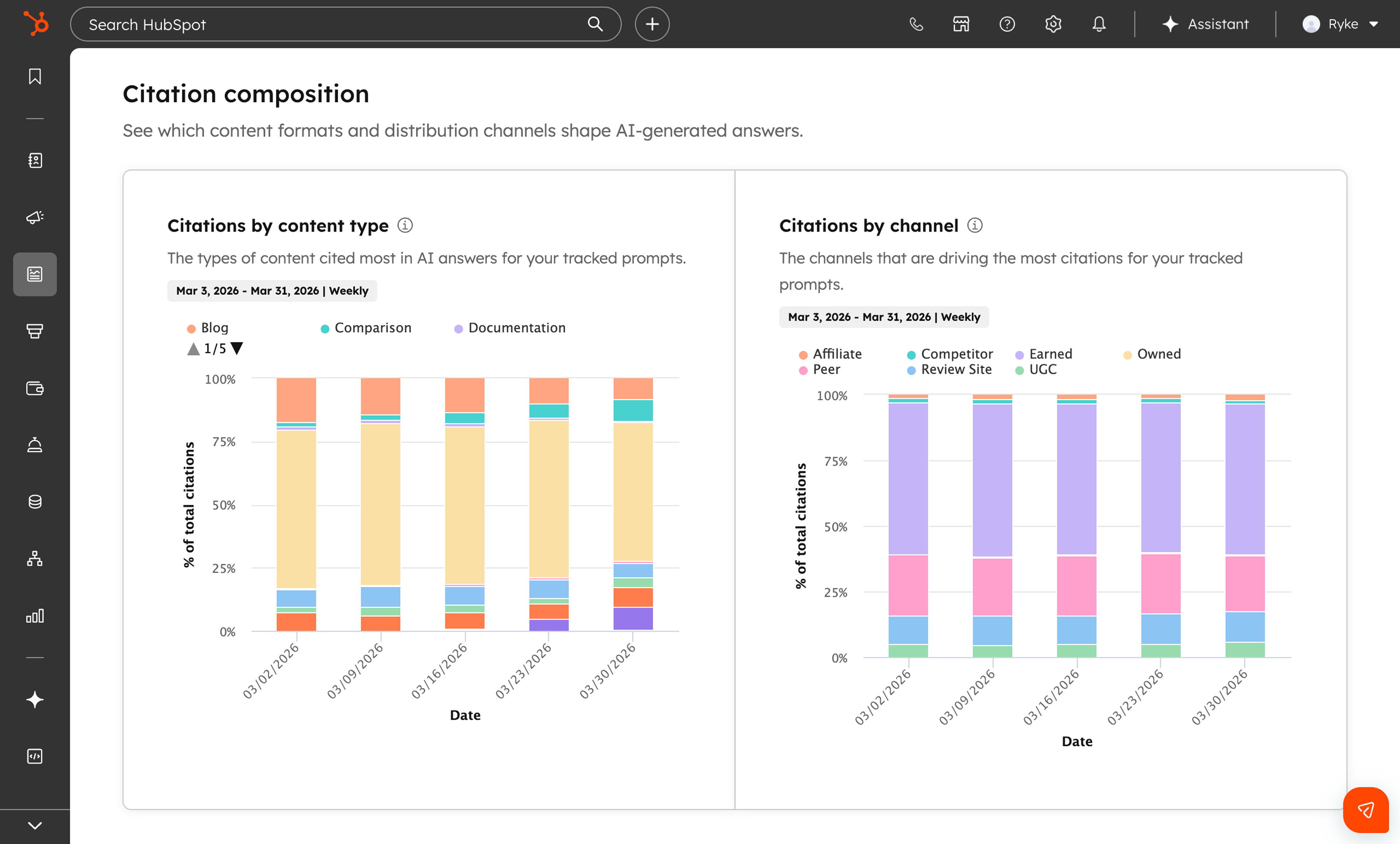
3. Citation Analysis
What it is: Understanding which specific content sources AI is pulling from when it makes recommendations.
Why it matters: AI doesn't make things up (well, not usually). It draws on specific sources. If you know which sources AI trusts for your industry, you can make sure your brand is represented in those sources.
Practical example: We found that for B2B services queries, AI heavily references HubSpot's partner directory, G2 reviews, and specific industry publications. For construction, it leans more on trade directories and project portfolio sites. Knowing this lets you focus your efforts where they'll actually move the needle.
4. Prompt Tracking
What it is: Identifying the actual questions and prompts that lead to AI recommending businesses like yours.
Why it matters: People don't ask AI the same questions they type into Google. AI prompts tend to be more conversational, more specific, and more intent-rich. "Best CRM for mid-size construction company with field teams" is an AI prompt. "Construction CRM" is a Google search. They require different content strategies.
Practical example: We maintain a library of the prompts that matter most for each client's industry. For construction, that includes things like "Which CRM handles job tracking and estimates?" For outsourcing: "What should I look for in a BPO partner in Southeast Asia?" These prompts guide our content creation - we write specifically to answer the questions AI is being asked.
5. Execution
What it is: Actually creating and distributing the content that improves your AI visibility.
Why it matters: All the analysis in the world doesn't help if nothing changes. Execution means updating your website content, generating more reviews, getting listed in the right directories, creating content that directly answers AI-friendly questions, and building your third-party mention footprint.
Practical example: For one client, execution looked like this: rewriting their service pages to use question-and-answer structure, launching a review generation campaign that doubled their Google reviews in 90 days, getting listed in three industry directories they'd overlooked, and publishing four case studies that highlighted specific outcomes. Within three months, they went from invisible to consistently mentioned in AI responses for their target queries.
What Good AEO Content Looks Like
Not all content helps with AEO. Here's what we've seen working well - and what doesn't.
Be Specific, Not Generic
AI models are trained on enormous amounts of text. Generic content ("We provide quality solutions for your business needs") blends into the noise. Specific content stands out.
Instead of: "We help businesses with their CRM"
Write: "We set up HubSpot CRM for construction companies that need to track jobs from estimate through to final invoice, with field team access on mobile"
The more specific you are about who you serve and what you do, the more likely AI is to match you with the right queries.
Structure for Questions
AI is answering questions. So structure your content around the questions your buyers actually ask.
Use clear headings that mirror real queries. Write in a way that directly answers the question in the first paragraph, then expands. Think of every section as a potential answer that AI could pull from.
Show Your Work
Credibility signals matter enormously. Case studies with real numbers. Client testimonials with names and companies. Project portfolios with outcomes. Awards and certifications.
AI isn't just looking for relevant content - it's looking for trustworthy content. Anything that demonstrates real experience and results gives you an edge.
Be Consistent Across Channels
Here's something that catches a lot of businesses out. If your website says one thing, your LinkedIn says another, and your directory listings say something different, AI gets mixed signals.
Consistency matters. Your messaging, your service descriptions, your positioning - they should be aligned across every channel. Not identical word-for-word, but clearly the same brand with the same story.
Answer the "Why You" Question
Most business content talks about what they do. AEO-effective content also explains why someone should choose them specifically.
What makes your approach different? What do your clients consistently say about working with you? What results have you delivered that prove your claims? These aren't just nice-to-have for AEO - they're the signals that tip AI toward recommending you over someone else.
How HubSpot's AEO Tool Changes Things
This is where our angle as a HubSpot Platinum Partner becomes relevant. Because HubSpot hasn't just acknowledged AEO as a trend - they've built a tool for it. And it's genuinely useful.
Most standalone AEO tools work from the outside in. They scrape AI responses, track mentions, and give you data. That's valuable, but it's disconnected from your actual business.
HubSpot's AEO tool works differently because it starts from the inside out.
It Starts with Your CRM Data
Here's what makes it genuinely different: it knows your business. Because it sits inside HubSpot, it has access to your contact data, your deal pipeline, your customer segments. It can generate smarter prompts based on who your actual buyers are - not generic industry assumptions.
A standalone tool might check "best CRM for construction." HubSpot's tool might check "best CRM for mid-size construction companies with 50-200 employees that need job tracking and field team access" - because it knows that's who your customers actually are.
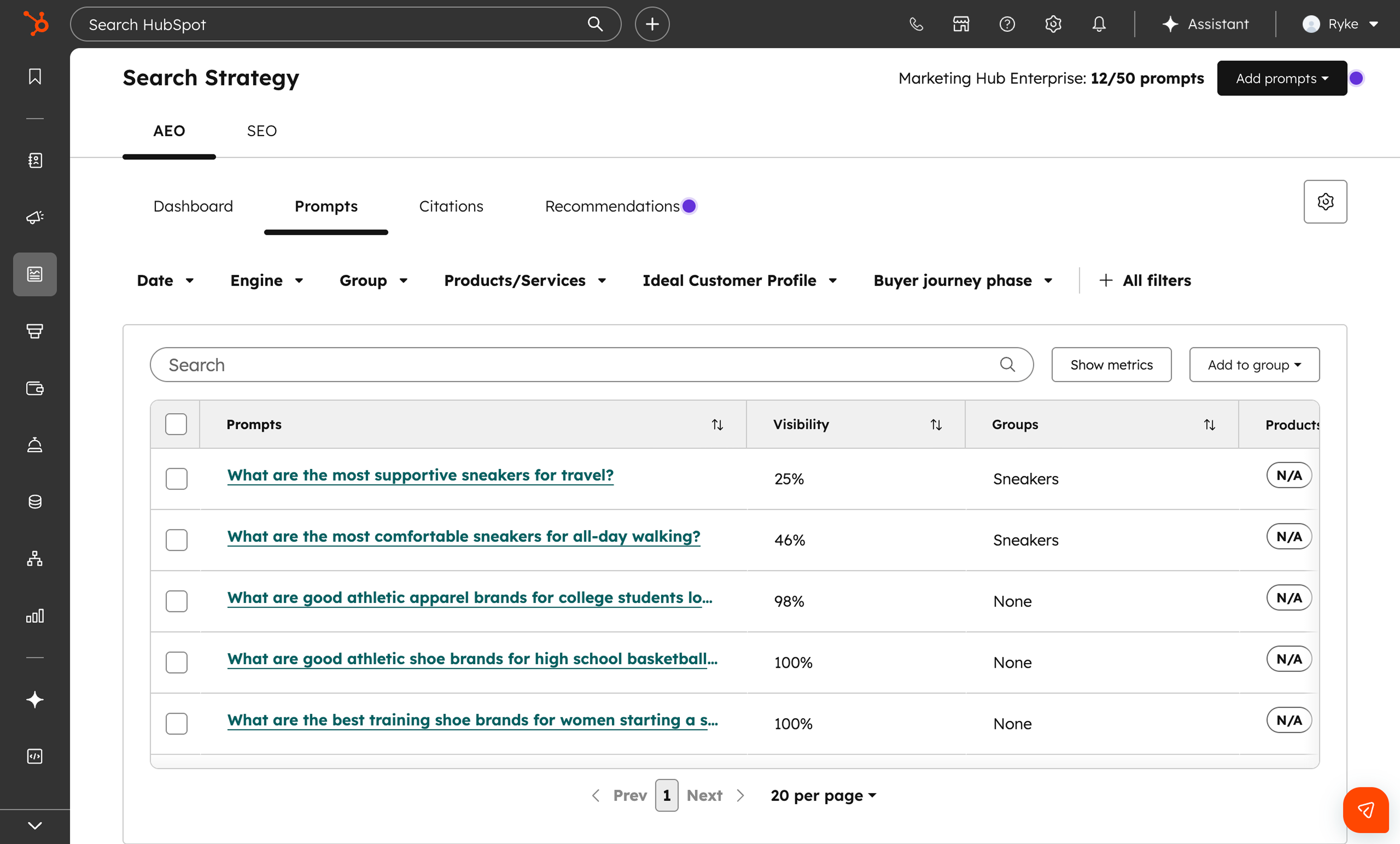
Smarter Prompts, Better Insights
The prompts it generates are grounded in reality. Instead of checking generic queries, it builds prompts around your buyer personas, your actual product descriptions, and your competitive positioning. That means the insights you get are specific to your situation, not one-size-fits-all.
Act Without Leaving the Platform
When the tool identifies a gap - say, your brand isn't showing up for a key query - you can act on it immediately. Create a blog post, update a landing page, adjust your messaging. All within HubSpot. No switching between platforms, no exporting data, no translating recommendations into actions.
For teams that are already running their marketing through HubSpot, this is a significant advantage. It reduces the distance between "we found a problem" and "we fixed it."
The Pricing Makes Sense
HubSpot's AEO tool is available as a standalone add-on for $50/month. If you're already on Marketing Hub Professional or Enterprise, it's included.
Compare that to standalone AEO tools: Profound, for example, charges $99/month for 50 prompt checks on a single AI engine. Other tools like Otterly and Peec AI have similar per-prompt pricing models. HubSpot gives you more prompts, multiple AI engines, and the CRM integration - at a lower price point.
For businesses already using HubSpot (which, if you're reading this on our site, you probably are or you're considering it), the value proposition is pretty clear.
What It Actually Shows You
The tool provides:
- Brand visibility scores across ChatGPT, Gemini, Perplexity, and other AI engines
- Competitor comparison - who's being recommended for the queries that matter to you
- Citation tracking - which of your content assets are being referenced by AI
- Prompt performance - how different question phrasings affect whether you show up
- Actionable recommendations - specific content and strategy changes to improve visibility
It's not magic. It's a measurement and execution tool. But in a space where most businesses are flying completely blind, having structured data to work with is a meaningful advantage.
What We've Seen in Practice
We work primarily with three types of businesses: construction and property, outsourcing, and B2B services. Here's what we're noticing about how AEO applies differently to each.
Construction and Property
This is an industry where trust and track record matter enormously. Buyers are making high-value decisions and they want to work with companies that have proven experience.
What we've seen: AI tends to recommend construction companies that have strong case study portfolios and detailed project descriptions. Generic "we build quality homes" messaging gets overlooked. Specific "we completed a 45-unit residential development in Western Sydney, delivered on time and 3% under budget" gets picked up.
Reviews matter a lot here too. Construction buyers check reviews as part of their due diligence, and AI models reflect that behaviour. Companies with 50+ Google reviews consistently outperform those with fewer, all else being equal.
The opportunity: most construction companies have great projects but poor documentation of them. Writing up completed projects as structured case studies - with scope, challenges, outcomes, and client quotes - is probably the highest-impact AEO activity for this industry.
Outsourcing
The outsourcing industry has a trust problem that AEO can help solve. Buyers are inherently cautious about outsourcing - they're handing over business processes to a partner they might never visit in person.
What we've seen: AI recommendations for outsourcing heavily favour companies with strong third-party validation. G2 reviews, Clutch profiles, industry awards, and client testimonials carry outsized weight. Companies that have invested in building their presence on review platforms show up far more often than those who haven't.
Content specificity matters here too. "We provide outsourcing services" loses to "We provide customer support outsourcing for Australian e-commerce brands with teams of 10-50 agents, with a 97% client retention rate over 3 years."
The opportunity: getting more detailed client testimonials and case studies onto review platforms, and making sure your website clearly articulates your specialisation rather than trying to be everything to everyone.
B2B Services
For B2B service businesses - marketing agencies, consultancies, technology providers - AEO is particularly interesting because these are exactly the types of businesses that people ask AI about.
What we've seen: partner credentials and certifications are strong signals. Being a HubSpot Platinum Partner, a Google Ads Partner, or holding other recognised certifications gives AI a clear credibility marker. Published thought leadership also matters - blog posts, whitepapers, and webinars that demonstrate expertise on specific topics.
The opportunity: B2B service businesses that publish consistently on LinkedIn and maintain active blogs tend to show up more in AI recommendations. The combination of owned content, social presence, and third-party credentials creates a strong signal profile.
Across All Industries
A few patterns we see regardless of industry:
- Consistency beats volume. Publishing one high-quality piece per week beats publishing five mediocre pieces.
- Specificity wins. The more clearly you define who you serve and what you do, the more AI can match you to the right queries.
- Reviews are underrated. Most businesses know reviews matter for local SEO. Fewer realise they're a major AEO signal too.
- Third-party mentions compound. Getting listed in directories, mentioned in roundup articles, and featured on partner pages creates a compounding effect over time.
Getting Started - The Quick Checklist
If you want to start thinking about AEO this week, here are practical steps you can take right now. No tools required. No budget needed.
This week:
☐ Open ChatGPT, Gemini, and Perplexity. Ask the questions your buyers would ask. See if your brand shows up. Write down what you find.
☐ Check your Google reviews. How many do you have? What's the rating? When was the last one? If it's been more than a month, start a review request process.
☐ Look at your website's service pages. Do they describe what you do in specific terms, or generic ones? Would an AI reading your site understand exactly who you help and how?
☐ Check your directory listings. Are you listed on the relevant directories for your industry? Are those listings complete and current?
This month:
☐ Write two case studies. Real projects, real numbers, real outcomes. Publish them on your website with clear, descriptive headings.
☐ Update your LinkedIn company page. Make sure the description matches your website messaging. Post at least weekly.
☐ Ask three happy clients to leave reviews on Google and one industry-specific review platform.
☐ Review your website's FAQ page (or create one). Structure it around the actual questions your buyers ask.
This quarter:
☐ Set up regular AEO monitoring - either manually or with a tool like HubSpot's AEO feature.
☐ Build a content calendar focused on answering the questions AI is being asked about your industry.
☐ Get listed in at least three industry directories or roundup articles you're currently missing from.
☐ Audit your brand consistency across all channels - website, social, directories, review platforms.
The goal isn't to do everything at once. It's to start building the signals that AI uses to decide who to recommend. And the businesses that start now will have a significant advantage over those that wait.
How GNG Can Help
We help teams set up AEO with purpose. Not just switching on a tool and hoping for the best.
What that actually looks like:
We start by understanding your business - who your buyers are, what questions they're asking, and where your brand currently shows up (or doesn't) in AI responses. Then we build a plan that meshes your business goals, your team's capacity, and the tools you're already using.
Because we're a HubSpot Platinum Partner, we can set up and configure HubSpot's AEO tool as part of a broader marketing strategy - not as an isolated add-on. We connect it to your existing CRM data, your content workflow, and your reporting so that AEO insights actually lead to action.
We also bring the Google Ads perspective. A lot of AEO work overlaps with what makes Google Ads campaigns perform better - clear messaging, specific landing pages, strong credibility signals. If you're running paid search alongside organic and AI discovery, having one partner who understands all three channels means nothing falls through the gaps.
Here's what we've learned over eight years of doing this work: the tool is never the answer by itself. It's the combination of clear strategy, clean data, consistent execution, and honest measurement that actually moves results. That's what we help with.
If you want to talk about what AEO could look like for your business, reach out to Alyssa at alyssa@gatherngrow.com or visit gatherngrow.com to learn more about how we work.
Gather 'n' Grow is a HubSpot Platinum Solutions Partner and Google Ads Partner, working with construction, outsourcing, and B2B services businesses across Australia and internationally. We help teams get more from their CRM, their ads, and their marketing - with clarity, not complexity.