
Your website is the front door to your business. You want it to give visitors a good experience, show them content that fits who they are, and send every enquiry straight into your CRM. Ideally, you also want your marketing team to make changes without waiting on a developer. (If you're on WordPress, that also means no more maintaining plugins or dealing with plugins that clash.)
So, what is HubSpot Content Hub?
Content Hub is HubSpot's content management system (CMS), the product that used to be called CMS Hub. It gives you what you need to build and manage the content on your website, and it's designed so that marketers, not just developers, can run it.
The main difference from other website platforms is that it sits on the same platform as your CRM. Your website, forms, emails and contact records all share one database.
Day to day, that means your team can update pages, publish landing pages and test changes themselves. Developers are still useful for building the theme and custom modules, but routine edits don't need to wait for them.
Why build on HubSpot?
1. Your Website and CRM in One Platform
With Content Hub, your website pages, blog, forms, landing pages and contact database all live in one place and talk to each other. You don't need separate tools stitched together with plugins and integrations.
Larger businesses can also run several brands or business units from one account, each with its own website or microsite.
2. Personalise The Entire Customer Experience For Every Visitor
Because Content Hub is built on HubSpot's CRM, you're able to personalise the entire customer experience, from a visitor’s first website visit, through every single marketing, sales and service touchpoint.
So instead of sending out generic content directed at a broad audience, you can dynamically tailor your content to individual visitors, so the message fits the person reading it.
You can also see each visitor's journey on their contact record, from their first website visit to a chat conversation, an enquiry form and, eventually, a purchase.

3. Built-In Security
Protecting your brand and your customers' data matters. HubSpot handles security for you, including SSL certificates on every site, a web application firewall, round-the-clock monitoring and incident response.
Hosting is included, so there's no separate hosting provider to manage or pay.
Because HubSpot is a closed platform that it maintains itself, there are no third-party plugins to patch and fewer ways for a site to be compromised.
HubSpot's website security page covers SSL, its CDN, compliance and page speed in more detail.
4. Drag and Drop Editing Makes Building Pages Easy
The drag and drop editor is the feature marketers tend to like most, because it doesn't need web development skills.
You can build and edit pages without custom code, using the modules your theme provides. That leaves more time for the content itself and less time spent waiting on fixes.
5. A/B and Adaptive Testing for Conversion Rate Optimisation
How is Adaptive testing different from A/B testing?
In a classic A/B test, you show each variation to half your visitors until you have enough data to pick a winner. In an adaptive test, the better-performing variation starts getting more traffic straight away, so you lose fewer conversions while the test runs.
You set up several variations of a page, and HubSpot monitors them and serves the best performer more often. Adaptive testing is available on the higher Content Hub tiers, so check your subscription.
How does it work?
Say you test four variations of a page. Traffic is split evenly at first. As HubSpot learns how each one performs, it shifts traffic so the stronger variations are shown more and the weaker ones less.
The traffic distribution of an adaptive test might look like this:
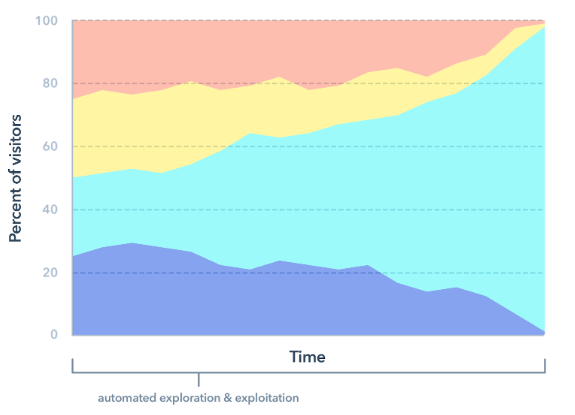
As you can see, the better variation wins out in the end.
6. Mobile Friendly, Responsive Pages
Your prospects are as likely to visit your website on a phone as on a laptop, so your site needs to work well on every screen size.
Making a site responsive by hand takes work. HubSpot's themes and templates are responsive by default, so your pages adapt to each device without extra coding.
A site that works properly on mobile is now a basic expectation, and it affects both conversions and search rankings.
7. Membership Areas, Multi-Language Sites and Dynamic Pages
If your company has offices in multiple countries, you’ll likely need your site in more than one language. Content Hub handles multi-language sites, including the hreflang tags search engines use to show the right language version.
HubSpot can also build pages from HubDB, a simple database inside HubSpot. Update a row in one place and every page that uses it updates too, so listings like locations, events or team members don't fall out of date.
These links explain each option in more detail:
- Membership website
- Multi-language website (still SEO friendly)
- Dynamic web pages (pages that pull their content from HubDB tables)
- Serverless functions (advanced: for developers and more technical marketers)
8. Built-In Tools for Lead Generation and Conversions
HubSpot lets you build your own CTAs, forms, pop-up forms and landing pages to turn website visitors into leads. You can also add live chat or a chatbot, or embed a calendar so visitors can book meetings directly with your sales team.
There's no separate form plugin to buy, and no risk of data getting lost between your forms and your CRM, because they're the same system.
9. SEO Recommendations and Topic Clusters
Rather than relying on a separate SEO plugin, you get SEO recommendations built into HubSpot's content tools, pointing out issues to fix and ways to improve how your pages rank.
When you create a web page, blog post or landing page, HubSpot checks it against on-page SEO best practices as you write and suggests fixes before you publish.
That makes it much harder for basic SEO issues to slip through.

You can also plan topic clusters in HubSpot, which gives you an overview of how your pillar pages and supporting content link together. You can include pages hosted outside HubSpot too.
How Content Hub Compares With WordPress
WordPress is often the cheaper option at face value, and it has the larger theme and plugin library. For ecommerce, WordPress with WooCommerce, or a dedicated platform like Shopify, is usually the better fit, because HubSpot isn't built to run an online store.
For lead generation businesses, the comparison changes once you count everything around the CMS. On WordPress, analytics, SEO, forms, security and often drag and drop editing all come from separate plugins, and each one needs updating, can clash with the others, and usually needs a developer to maintain. Security is your responsibility because the platform is open source.
On HubSpot, those pieces are built in, hosting and security are handled for you, and every form fill lands in the CRM. When you add up plugins, hosting, security, maintenance and the time spent waiting on developers, HubSpot often works out as the simpler choice over the long run.
Is HubSpot Right for Your Website?
HubSpot is more than a CMS. It brings your website, CRM, marketing, sales and service into one platform, so your team works in one tool instead of several.
If you're weighing up a move to HubSpot and want it set up properly from the start, we can help. See how we implement HubSpot.