
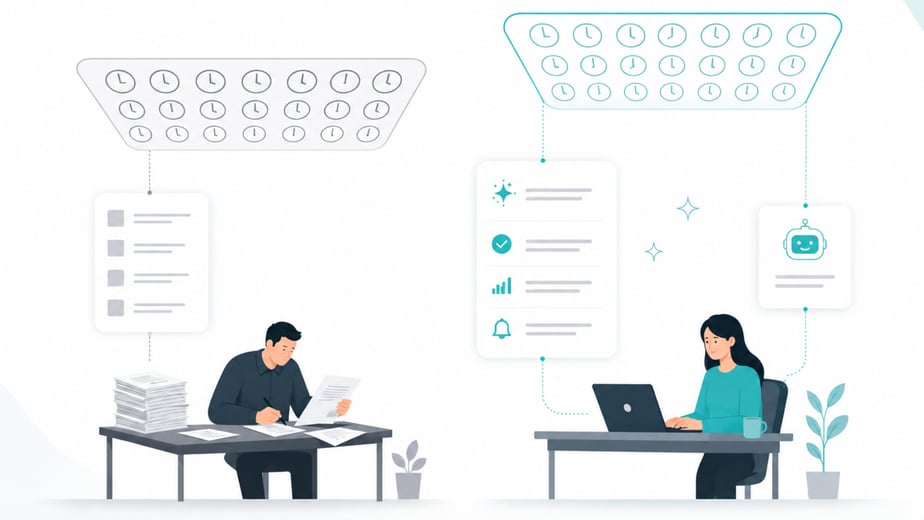
The traditional Google Ads agency model is not broken. It built the industry, and plenty of good people still run accounts well inside it. But it has a ceiling, and that ceiling is made of hours. There are only so many in a week, and in the old model every one of them is spent by hand. That single constraint quietly shapes what your account actually gets.
The AI-augmented model lifts that ceiling. Not by replacing the people, but by taking the manual grind off their plates so their hours go further. The difference shows up in things you can feel: how much gets tested, how deep the analysis goes, how fast someone responds when something moves. Here is the honest comparison.
How the traditional model works, and where it strains
In the traditional setup, one account manager carries a stack of clients, and everything is done manually. They pull the data by hand. They eyeball the search terms, usually a sample, because reading every one is not realistic across a full client load. They build the report from scratch each month. They make the changes one at a time.
When that person is good, the work is good. The strain is not about talent. It is arithmetic. Every manual task competes for the same finite hours, so something always gives. The deep analysis gets done in the months that are quiet and gets thinner in the months that are not. The search-term review covers the top slice and misses the long tail where waste hides. The account gets a fuller look or a lighter one depending on how the rest of the week went. None of that is anyone failing. It is what happens when limited hours meet unlimited manual work.
How the AI-augmented model works
We run the same fundamentals, with one change underneath. The repeatable work is systematised, documented and done to a standard every time, so it is consistent and quicker and does not eat our people's hours.
The audit runs as a defined process in minutes instead of being assembled by hand. Every search term gets read and sorted, not just the top of the list. The data for your report is pulled and laid out automatically. The mechanical, repeatable parts of the job happen fast and consistently, the same way every time.
That is not the headline, though. The headline is what it does to the human hours. They stop being spent on assembling and start being spent on thinking. Our people are not buried in data pulls and manual sorting. They are working on what the data means, what to test next, and where the real opportunity sits. Same fundamentals as the traditional model. The grind just stops competing with the judgment for the same finite time.
What actually changes for you
More testing. When setting up and reviewing tests is not a manual time-sink, more of them happen. More tests mean more learning, and more learning is what compounds an account over time.
Deeper analysis. The hours freed from mechanical work go into looking harder at your account. Patterns get spotted that a sampled, rushed review would miss. The long tail of search terms gets read, not skimmed, which is exactly where quiet waste tends to live.
Faster response. With systems watching the repeatable signals, issues tend to surface sooner rather than sitting unnoticed. That still depends on collecting enough data to know something is real, AI does not remove the need for time and data, but spotting a problem earlier usually means a smaller fix.
The same thinking, or better. The strategy, the judgment, the diagnosis of what is really going on, all of that still comes from a person who knows your account. It does not get automated away. It gets more of their attention, because they are no longer rationing time against a pile of manual tasks.
What does not change, and what we will not claim
We want to be fair to the traditional model and honest about the trade-off, so two clarifications.
First, AI does not run your account in our model. It executes the repeatable work. It does not set your strategy, make the judgment calls, or own the result. Those stay with people, deliberately, because a live ad budget is no place for a system that is confident whether it is right or wrong. If anything, the human judgment gets more room here, not less.
Second, the trade-off is real and worth naming. The traditional model is simpler and entirely hand-run, and for a small or very straightforward account that can be perfectly enough. The AI-augmented model earns its keep when there is enough going on that the repeatable work genuinely competes with the thinking for time. That is most accounts of any size, but not all, and we would tell you if yours sat on the other side of that line.
The short version. Same human judgment at the centre. Systems handling the grind so that judgment gets more hours, not fewer. For most accounts, that means more testing, deeper analysis, and faster response for the same spend.
If you want to know what your account is getting today versus what it could be, that is a straightforward conversation, and an honest one. We are happy to have it.